Most travelers assume a resort pool or beach comes with a watchful lifeguard as standard. In reality, resort water safety varies enormously from one property to the next. Some resorts staff full-time lifeguards at every pool, while others post a few rules on a sign and expect guests to supervise themselves. Beach flag systems may be run by the resort, or by local authorities on a shared public beach.
This guide walks through how it all works in practice: why safety setups differ between hotels, how pools are designed with depth and zoning in mind, what lifeguards actually cover during their shifts, and how to read beach flags before you swim. We’ll also cover how to choose a resort with the water setup your family needs, and the simple habits that make every swim safer. A few minutes of preparation before booking can make a real difference once you arrive.
Why Resort Water Safety Differs From Hotel to Hotel
The biggest surprise for many guests is that there is no universal standard for pool supervision at resorts. Some properties employ full-time lifeguards who watch every pool during opening hours. Others take a different approach entirely: they post depth markers and rules around the pool deck and expect adult guests to supervise themselves and their children. Neither setup is automatically unsafe, but they demand very different behavior from you as a traveler.
Beaches can complicate things further
If your resort fronts a public beach, the flag system and any lifeguard coverage may be run by local authorities rather than the hotel. That means the resort often has no control over when flags are raised or whether the beach is patrolled at all. Two neighboring properties can share the same stretch of sand with completely different levels of oversight, so it pays to ask specifically about the beach in front of your room, not just the pools.
All-inclusive and family-focused resorts tend to have the strictest pool rules of all. Expect wristband checks at pool entrances, designated kids’ zones separated from the main pool, and enforced quiet or adult-only areas. These rules exist to keep crowded pools manageable, and staff will usually enforce them consistently. If you prefer a more relaxed atmosphere, a smaller boutique property may suit you better, provided you understand you’ll likely be supervising your own swimmers.
How Resort Pools Are Set Up for Safety
Resort pools are usually designed with safety zoning built in from the start. Depth markers and “no diving” signs are posted along the pool edge, and the layout typically follows a familiar pattern: a shallow end around 0.9 m deep, sloping down to deep sections of 2.5 m or more where diving may be permitted. Learning to spot these markers on your first walk around the pool takes seconds and tells you exactly where weak swimmers can stand safely.
Swim-up bars are a signature resort feature, and they are deliberately built shallow. Most sit in water roughly 0.9 to 1.2 m deep, so guests can stand comfortably with their heads well above water while ordering a drink. That said, shallow water is not risk-free: diving into a swim-up bar area is dangerous, and children should still be watched closely there.
What the design features mean for you
- Kids’ pools and splash zones are kept under 0.5 m deep and are often fenced or gated, so check whether the gate self-latches and whether your toddler can reach the latch.
- Posted pool hours, commonly 7:00 to 22:00, exist because lighting and supervision drop after dark; an evening swim in an unlit pool is far riskier than it looks.
- Depth transitions between shallow and deep sections can be sudden, so non-swimmers should stay well inside the marked shallow zone rather than drifting toward the slope.
Pool hours are not arbitrary. Many resorts restrict pool access to daylight hours and close pools at dusk, when lifeguards go off duty and underwater hazards become hard to see. Treat closing times as a hard limit, not a suggestion.
What Lifeguards Actually Cover at Resorts
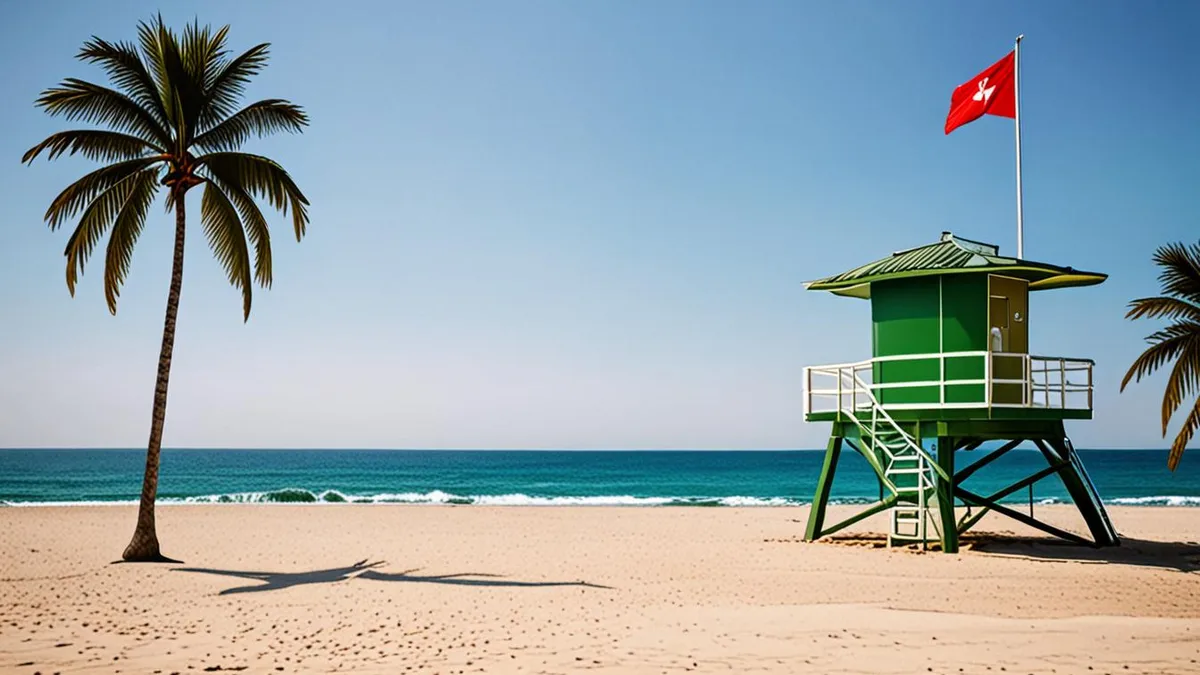
Lifeguards at resorts are real, trained professionals, but their coverage has clear limits. At the pool, lifeguard shifts usually match the posted hours, often running from morning until around 22:00. Swim outside those hours and you are on your own, even if the pool gate is technically open. Night swimming after a few cocktails is one of the most common ways guests end up in trouble.
Beach coverage is seasonal
Beach lifeguard coverage is often seasonal rather than year-round. In the northern hemisphere, patrols are typically busiest from June to August, and coverage can shrink or disappear outside that peak. A beach that was fully lifeguarded on your July visit may be completely unpatrolled in October, so never assume last year’s setup still applies.
It’s also important to understand what a lifeguard is actually watching. Lifeguards supervise the water, not your children. A guard scanning a crowded pool cannot track one specific toddler for an entire shift, so the arm’s-reach rule for young kids still applies even with a guard on duty. International lifeguard standards recommend adult supervision within arm’s reach for young children around water, and that holds true at the most heavily staffed resort.
The simplest solution is to ask at check-in: which pools and beach zones have coverage, and at what times. Get specific answers, and note whether any fees or restrictions apply to certain facilities, since extras like reserved cabanas or kids’ club pool time sometimes work differently. If charges start stacking up, it helps to know what resort fees really cover and how to budget for them before you arrive. Understanding what your stay actually includes beats discovering gaps in supervision after you’ve unpacked.
Reading Beach Flags Before You Swim
Most beach destinations that cater to tourists use a color-coded flag system, and it is worth learning the basics before your first swim. The colors are consistent across many countries, so once you know them, you can read a flagpole almost anywhere, from the Caribbean to a coastal resort in Brazil.
Green signals calm conditions where swimming is generally considered safe. Yellow warns of moderate hazards, such as stronger currents or chop, so weaker swimmers should stay close to shore. Red flags mark high hazard conditions, and swimming is discouraged even for strong swimmers. Red over red is the most serious display of all: the water is closed, and going in is not allowed.
- Purple flags do not describe surf conditions at all; they warn of dangerous marine life, most commonly jellyfish, so check the sand near the waterline before letting kids play at the edge.
- Flags are live updates, not decoration. Conditions can shift within hours, so glance at the flagpole every single time you head to the water, not just once in the morning.
- No flags mean no supervision. If a beach has no flag system at all, treat it as an unsupervised wild beach and ask resort staff about currents, tides and recent hazards before swimming.
One practical tip: take a photo of the flagpole on your first morning and ask staff what each color means locally. A few regions add their own variations, and a thirty-second conversation can prevent a bad surprise later in the week. Staff can also point out which stretch of sand in front of the property is actually patrolled, since the lifeguarded zone does not always match the resort’s loudest lounge chairs.
Choosing a Resort With the Water Setup You Need
The water setup at a resort is decided long before you arrive, so it makes sense to check it before you book rather than after you unpack. Start by looking at how the property describes its pools and beach. Vague wording like “swimming available” tells you very little; specific mentions of lifeguard hours, gated kids’ pools and depth markers suggest a property that takes safety seriously.
If you are traveling with young children
Prioritize resorts with fenced or gated kids’ pools, shallow, gradual entries into the main pool and lifeguard hours that are actually published, not just promised. Ask the resort directly whether the children’s pool is supervised and at what times, since answers vary widely even within the same star rating.
If the beach is the main draw
Beach-focused travelers should confirm whether the resort fronts a lifeguarded section of sand or a wild, unsupervised one. Some beachfront properties share public beaches where flags and lifeguards are managed by local authorities, not the hotel, so coverage may be seasonal or absent. If your heart is set on swimming in the ocean every day, this question matters more than pool photos on the booking page. Our guide on how to choose a resort walks through comparing properties in more detail.
Adults-only and couples resorts deserve a separate mention. They often have quieter pools with fewer rules, which is part of their appeal, but fewer rules can also mean fewer safeguards, such as no dedicated lifeguard at all. That trade-off suits many travelers perfectly; just make it knowingly by comparing how each property describes supervision before you commit.
Simple Habits That Make Resort Swimming Safer
Good habits matter as much as the resort’s own safety setup, and most of them take seconds to follow. The first rule is simple: swim only during posted pool hours, which at many resorts run from roughly 7:00 to 22:00. Outside those hours there is no lifeguard, lighting is poorer and pools may close at dusk, so a late-night swim is never worth the risk. The same goes for swimming alone or after drinking, both of which turn minor slips into serious incidents.
Supervision of children is your job, not the lifeguard’s. A guard watching a busy pool cannot track one specific toddler the way a parent can, so keep young children within arm’s reach whenever they are in or near the water, even when coverage is active.
- Check the flag on every beach visit. Conditions change during the day, and a calm-looking sea under a red flag can hide strong currents that are invisible from the shore.
- Do a safety walk on day one. On your first loop around the pool, locate the nearest lifeguard station, the first-aid point and the depth markers so you are not searching for them in an emergency.
- Respect closures without debate. If the water is closed, obey it regardless of how inviting it looks; staff close beaches for reasons you may not be able to see from the sand.
None of this requires effort once it becomes routine. Arrive, walk the grounds, note the flag and the hours, and then relax and enjoy the water with the peace of mind that comes from knowing your surroundings.
Wrapping Up Resort Water Safety
It’s easy to assume someone else is watching the water when you’re on vacation, but that assumption can let you down. Resort water safety depends on pool design, lifeguard hours and the beach flag system in place, and these vary widely from one property to the next. Some resorts staff lifeguards throughout posted hours, while others rely on signage and expect guests to watch themselves.
The basics are simple to remember. Green, yellow, red and purple flags each signal different conditions worth checking before you swim, and supervision and simple habits matter as much as the resort’s own setup. Swim during posted hours, keep young children within arm’s reach, and glance at the flagpole every time you head to the water. If this helped you plan a safer trip, leave a comment or share the article with a fellow traveler.