Finding wheelchair-friendly resorts can be surprisingly frustrating. Many properties describe themselves as “accessible” when all that really means is a ramp at the entrance or an elevator in the lobby. Travelers arrive expecting a usable stay, only to discover the guest room has a bathtub instead of a roll-in shower, or the bathroom doorway is too narrow for a chair to pass through. The gap between marketing claims and reality leads to stressful arrivals, wasted money, and vacations that simply don’t work.
This guide walks you through the whole process of finding a stay that genuinely fits your needs. We’ll explain what accessibility labels actually mean, which room features to verify before you book, and how to check that pools, restaurants, and grounds are reachable too. You’ll also learn how to ask resorts the right questions, when to book to secure limited accessible rooms, and how to budget and compare options fairly. With the right preparation, you can book with confidence instead of crossing your fingers.
What Wheelchair-Friendly Resorts Really Mean
The biggest mistake travelers make is assuming that “accessible” means the same thing everywhere. In the United States, the Americans with Disabilities Act (ADA) sets specific requirements for hotels and resorts, covering things like room design, bathroom layouts, and common areas. Properties that are ADA-compliant have been built or renovated to meet those measurable standards. That’s very different from a resort that simply offers a ground-floor room and calls it accessible, since a room on the ground level can still have steps at the entrance, a raised bed, or a bathroom you can’t maneuver in.
Another common trap is partial accessibility. A resort may advertise an accessible lobby, an accessible pool, and an accessible restaurant, while none of the guest rooms themselves are usable for a wheelchair user. Since you’ll spend most of your time in the room, that’s the feature that matters most. Always ask specifically about the rooms, not just the property.
Traveling internationally
Once you leave the US, ADA standards may not apply at all. Some countries have their own accessibility regulations, while others have no formal requirements, leaving each resort to decide what “accessible” means on its own. That doesn’t mean international stays are off the table, but it does mean you need to verify every feature yourself rather than relying on a label. Ask detailed questions, request photos, and get answers in writing before you commit to a booking.
Room Features to Verify Before Booking
The guest room is where accessibility claims fall apart most often, so verify the details before you pay. Start with the basics: doorway widths of at least 32 inches are the common accessibility standard, and you’ll want roughly 60 inches of turning space inside the room so you can move around the bed and furniture comfortably. A room that technically fits a wheelchair but offers no room to turn is not a usable room.
The bathroom deserves the closest inspection. Roll-in showers and grab bars are the key bathroom features to confirm, because a step-over tub or a shower with a high lip can make an otherwise good room unworkable. Ask specifically whether the shower has a fold-down bench and a handheld showerhead, and whether the grab bars are positioned in the shower and near the toilet.
- Bed height: Ask for the exact measurement from the floor to the top of the mattress, since a bed that’s too high or too low makes transfers difficult. Some resorts can add or remove a bed frame to adjust it.
- Closet rods: Confirm whether the closet has lowered rods or shelves you can actually reach, or ask if the resort can provide a rolling garment rack instead.
- Light switches and thermostat controls: Check that both are mounted within seated reach, since standard-height switches and wall-mounted thermostats are easy for a resort to overlook.
- Under-counter clearance: If the room has a kitchenette or desk, ask whether there’s open space underneath so you can roll up close and use it.
Get answers to each of these questions in writing. A specific, written reply tells you far more than a generic “yes, we’re accessible” from a reservations agent.
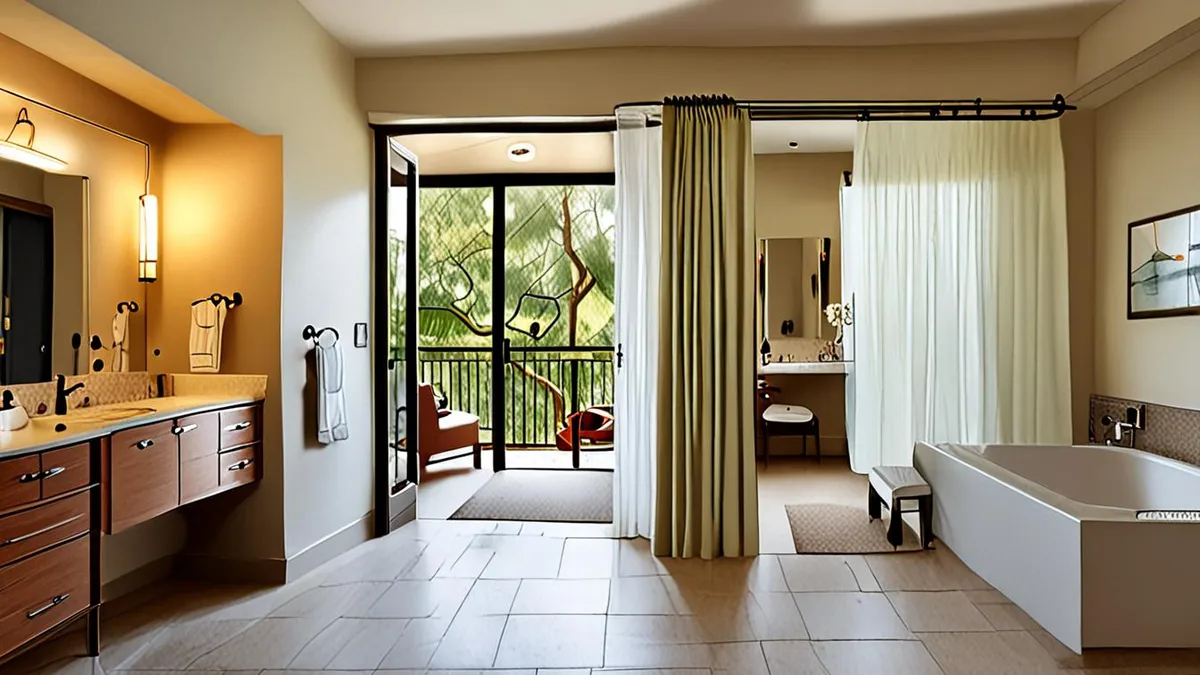
Resort-Wide Accessibility: Pools, Dining and Grounds
A fully accessible room doesn’t help much if you can’t reach the pool, the restaurant, or the beach. Resort-wide access is the second half of the equation, and it’s where many properties quietly fall short. Before booking, verify that there are step-free routes from your room to the restaurants, beach, spa, and elevators. Resorts with multiple levels, garden paths, or split-level dining areas often have steps in places a map or brochure won’t show, so ask staff to walk the actual route and describe it to you.
Pools and beach access
Pool lifts or zero-entry pools are the main accessible pool options to look for. But don’t stop at confirming that a lift exists, because lifts are sometimes installed and never maintained. Ask directly whether the pool lift is currently working and how often it’s serviced. If you plan to spend time at the beach, ask whether the resort offers beach or pool chairs designed for sand and water, and whether they need to be reserved in advance.
Getting around the property
Larger resorts, especially those spread across big grounds or multiple buildings, often rely on shuttles to move guests around. Ask whether accessible shuttle transfers with a ramp or lift are available, and whether they operate on demand or on a fixed schedule. Also confirm how the resort handles luggage assistance and whether any on-site charges apply, since extra costs can add up quickly. For a clearer picture of what resorts typically charge for beyond the room rate, it helps to read what resort fees really cover and how to budget for them. A resort that answers these questions promptly and specifically is usually one that takes accessibility seriously, and that responsiveness often predicts how smooth your stay will be once you arrive.
How to Ask Resorts the Right Accessibility Questions
Phone calls leave you with nothing but a memory of what someone said. When it comes to accessibility features, that memory is not enough, because verbal promises are easy to misunderstand and impossible to prove later. A short, specific email thread protects you far better. It creates a dated record of exactly what the resort agreed to, who said it, and when. If a front desk clerk at check-in claims they never heard about your needs, you can simply open your inbox and show them.
- Email the resort instead of calling. Ask about each feature by name: the roll-in shower, grab bars, doorway widths and pool access. A written reply gives you documented confirmation you can reference at check-in if something does not match. Keep the thread in one place rather than scattering questions across separate messages, so nothing gets lost.
- Request photos of the actual accessible room. Marketing images usually show standard rooms or the newest suite. Ask specifically for recent photos of the accessible room you would be assigned, its bathroom, and the route or lift used to enter the pool.
- Reconfirm before you travel. Send a follow-up email one to two weeks before arrival to verify your accessible room is still reserved, then confirm again at the front desk when you check in. This catches mix-ups while there is still time to fix them.
Treat these exchanges as part of your trip planning, not an extra chore. A resort that answers your questions promptly and in detail is often a good sign of how seriously it takes accessibility overall. Vague or slow replies are worth weighing into your decision before you pay. If a property hesitates to put basic answers in writing, that hesitation tells you something useful. Save every reply in a dedicated folder, along with the names of the staff members who responded, so you can follow up with the same person if anything changes before your arrival.
Booking Strategy for Wheelchair-Friendly Resorts
Even the most thorough questions will not help if the accessible room is gone by the time you try to book. Scarcity is the biggest obstacle in accessible travel, and it shapes almost every smart booking decision.
Book early and book direct
Accessible rooms are limited inventory, often only 1-5% of the total rooms at a resort. That means a property with two hundred rooms might have just a handful that truly meet your needs, and they sell out first among travelers who need them. Aim to book 3-6 months ahead, and stretch that window even longer for peak season trips.
Whenever possible, book directly with the resort rather than through a third-party site. When you reserve direct, your accessibility requests are attached to your actual reservation. Third-party bookings can pass along a room type but often lose the specific notes about grab bars, a roll-in shower or a particular floor, and sorting that out later is frustrating.
Timing your stay
Shoulder season is worth serious consideration. Resorts are quieter, so staff have more time to give attention to access needs, whether that is helping with a pool lift or making sure a route stays clear. You may also find more flexible room availability and calmer common areas, which makes getting around the property easier day to day.
Budgeting and Comparing Accessible Stays
Accessible stays do not have to break your budget, but comparing them fairly takes a little extra math. The headline nightly rate rarely tells the whole story, and two resorts that look similarly priced can end up far apart once fees, taxes and dining are added in. Before you commit, build a simple side-by-side comparison that includes every recurring charge for your entire stay, not just the room itself.
Across the Americas, budget-friendly accessible options often start around $80-150 per night, though prices vary widely by country, season and resort size. When you compare, look at the total cost of your stay rather than the base rate, and remember that accessibility features themselves should never carry a surcharge. If a resort quotes more for an accessible room, ask why. Since accessible rooms are often a small share of total inventory, the cheapest property with no availability is not a bargain at all.
- Resort fees: Many properties add mandatory resort fees of roughly $20-50 per night on top of the room rate. Add these to your comparison, since they can swing the total cost of a week-long stay significantly.
- All-inclusive versus a la carte: If dining access and on-site convenience matter most to you, an all-inclusive rate may be worth the premium. It reduces the need to leave the property for meals, which matters when step-free routes and transportation are a factor.
- What the rate includes: Check whether accessible shuttle transfers, beach or pool chairs, and equipment storage are bundled or billed separately, since these add-ons affect your real daily cost.
Once you line up total costs side by side, the cheapest sticker price is not always the best value for an accessible trip. A slightly higher rate at a resort with verified features, fair fees and no accessibility surcharges usually beats a rock-bottom price that comes with surprises. Choose the option that keeps the features you verified intact from booking to checkout, and get every cost and commitment in writing before you pay.
Wrapping Up Your Accessible Resort Search
Finding a resort that is genuinely wheelchair-friendly comes down to one thing: verification. A property that simply advertises itself as accessible may have a step-free lobby but a bathroom you cannot use. A truly accessible stay combines verified room features, like a roll-in shower with grab bars and doorways wide enough for your chair, with step-free access to the pool, restaurants and grounds.
Because accessible rooms are often only a small share of a resort’s inventory, early booking and written confirmation of every feature protect you from arriving to find nothing available. Careful questioning before you pay is the single best way to guarantee a comfortable stay, so never rely on verbal promises or glossy marketing photos. If this guide helped you plan a trip, or you have a tip of your own, leave a comment or share it with a fellow traveler.